After hundreds of hours preparing our BMW E46, it was finally time to race. We had an 18-year-old car with 240,000 miles, a team of good friends, and a whole weekend of endurance racing ahead of us. What could go wrong?
Well, quite a bit. My first stint ended after only five laps because I overheated. Then our engine sent a connecting rod through the block. Before long, our first race weekend had turned into an all-night junkyard engine swap.
But the weekend wasn’t just a disaster. It was our first real lesson in what endurance racing takes, from passing inspection and managing driver heat to solving problems with help from the teams racing against us.
Getting Our $500 BMW Ready for Thunderbolt Raceway
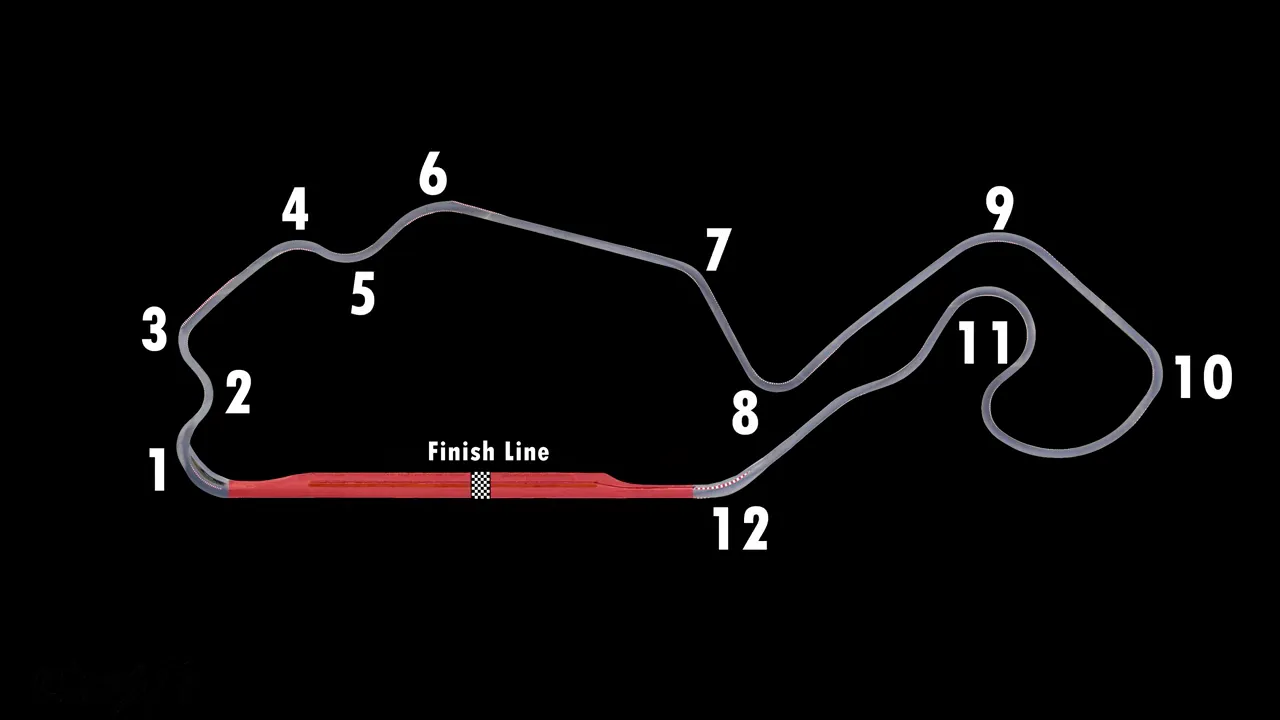
Our first race took place at New Jersey Motorsports Park in southern New Jersey, on the Thunderbolt circuit. This is a roughly 2.25-mile track with 12 challenging turns and a half-mile straight where we would reach around 100 mph. Not exactly an easy place to learn wheel-to-wheel racing.
We were officially the Soapy Water Racers, so naturally, the front bumper needed soapy water decals. Garrett was finishing the sponsor decals, too. A complete livery would have to wait. We had some awesome design ideas, but getting the car ready to race came first.
The BMW already had its roll cage, fire suppression system, battery cutoff switch, containment racing seat, and six-point harness installed. That was a huge amount of preparation, but installing everything wasn’t enough. Before we could enter the track, we had to prove it was safe.
Safety Tech Inspection: No Shortcuts Allowed
Our safety inspection took about 15 minutes, and it was thorough. Jay Lamm, the founder of the 24 Hours of Lemons, went through the car to check that our preparation met the requirements.
Some of the important checks included:
- Roll cage: Correct construction, bends, welds, and mounting plates.
- Windshield: No damage that could compromise its strength or obstruct the driver’s view.
- Cabin wiring: Organized and secured rather than hanging loose.
- Seat and harness: Proper installation and acceptable expiration dates.
- Brake lights and battery cutoff: Functional checks, including shutting off the running engine with the cutoff switch.
- Firewall: No unsealed holes.
- Fuel system: Sound feed lines and no rust-related concerns.
- Battery: Securely mounted in its case, with covered terminals.
- Loose equipment: Items such as the cool-suit cooler secured in place.
We also confirmed that the cooling system contained water rather than antifreeze. We had drained and flushed it four times during preparation.
If something fails safety tech, you fix it and get it reinspected before racing. There isn’t any leeway just because you worked hard or drove a long way to get there. That is exactly how it should be.
This list is only part of the inspection, not a substitute for the complete requirements. Anyone preparing a car should work through the tech sheet before arriving and check the official Lemons rules for current requirements.
|
Proving Our BMW Belonged in a $500 Race
Passing safety tech was only the first hurdle. Next came the Lemons budget inspection, appropriately called BS inspection.
The idea is affordable racing with cheap cars, so Judge Eric needed to decide whether our E46 was believable as a $500 car. There was one obvious complication: we had paid $1,100 for it.
To bring the car’s value down, we sold parts we no longer needed, including dashboard pieces, speakers, and radio equipment. Just as importantly, we documented those sales. Ari brought photos of the parts and records of the payments so we could show where the money came from.
We weren’t asking the judge to take our word for it. We wanted to play fair and had the records to back it up.
After looking over the paperwork, the stock engine, and the overall condition of our field-found BMW, the judge accepted it as a $500 car. We were placed in Class A, the fast class, with zero penalty laps.
With both inspections complete, we picked up the transponder that would count our laps. We were cleared to race, but the process had taken longer than expected. There was only about an hour left before the start.
Final Checks Before My First Racing Stint
This was where having an entire team really helped. While I got suited up, Aaron and Ari handled the last checks.
The engine oil had been changed two days earlier, and the level looked good. Next came tire pressures. For our setup, we started at 27 psi cold, expecting the heat generated on track to bring the pressures to roughly 35 to 40 psi hot.
Those were our starting numbers for this car and tire setup, not a universal recommendation. The important part was recording them. Aaron checked the tires while Ari wrote down the readings so we could compare them throughout the race. Once we established the hot pressures, changes could help flag a developing problem.
Then it was time to get strapped in. The team checked my harness and HANS device, helped install the quick-release steering wheel, and guided me out of our paddock spot.
After all those hours building the car, we were finally operating like a real race team. None of us had done this together before, but everybody had a job and everybody was focused.
Learning Wheel-to-Wheel Racing With More Than 125 Cars
We missed the start by about two minutes. That wasn’t ideal, but it wasn’t worth rushing the final checks to avoid it. We were preparing for many hours of racing, not a short sprint.
The nerves really kicked in as I approached the track. Cars were flying past, and I was about to merge into them for my first wheel-to-wheel race.
One thing became obvious immediately: a containment seat, helmet, and full safety gear make your field of view much more restricted than it is in a street car. Getting onto the track safely took my full attention.
Once I merged, I kept my first-lap goals simple:
- Learn the track.
- Learn how the BMW behaved.
- Stay on the pavement.
- Avoid cutting anybody off.
There were more than 125 cars out there, with different speeds and drivers of different experience levels. Plenty of people passed me on that first lap, and that was completely fine. Trying to drive at the limit before understanding the car and the circuit would have been the wrong approach.
After a lap, the layout started to make sense. I was learning where I could stay on the gas and where I needed to brake. The BMW felt amazing, and as I got more comfortable, I began pushing harder and making passes.
We also found an equipment problem that needed fixing before the next race: our single rearview mirror wasn’t enough. A full-width panel mirror went onto the improvement list because I needed a better view of traffic behind me.
Our camera setup had its own problem. The forward-facing camera suffered a memory card error, leaving us with only the cabin angle from my stint. It was a frustrating reminder that even the recording equipment needed a reliable pre-race routine.
Five Laps Were Enough to Overheat the Driver
The car was doing great. I was not.
When I headed out, the cabin temperature was about 92°F. By only the third lap, it had climbed to 115°F, and it was still rising.
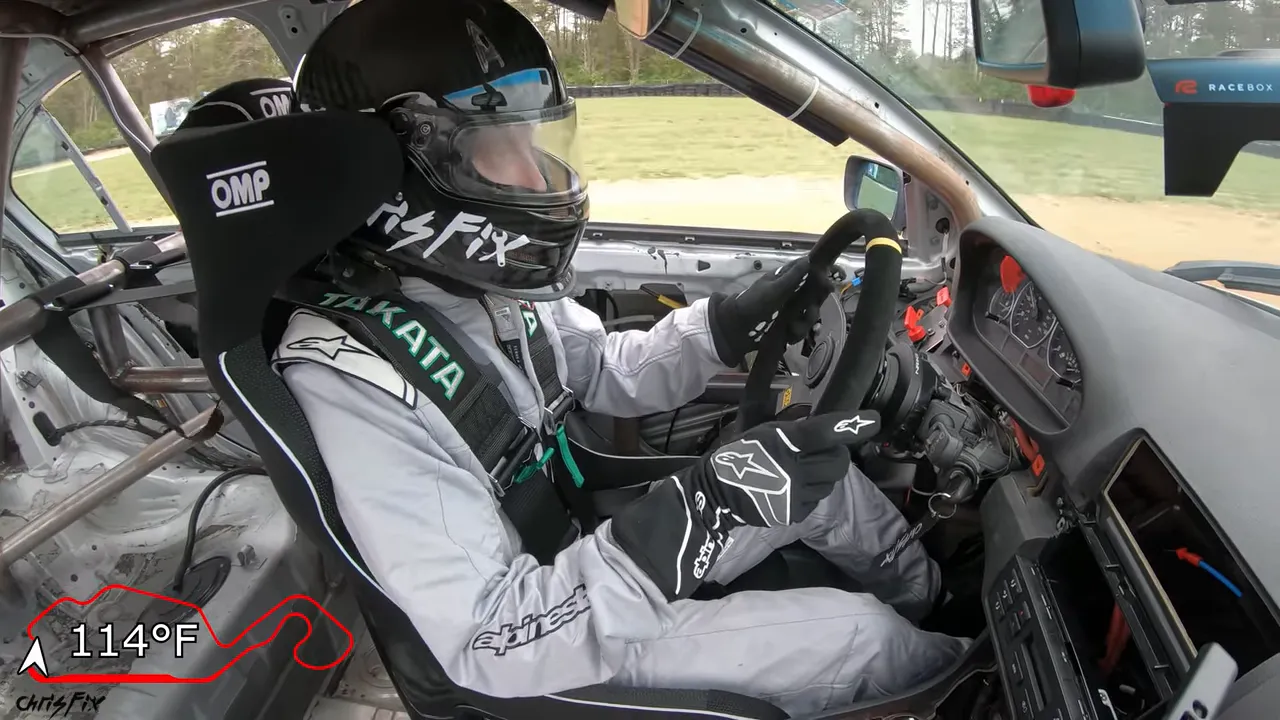
We had a cooling suit ready, but in the rush to get on track, we hadn’t connected it. We figured the first driver could get away without it.
That was a big mistake.
My visor started fogging, and I began feeling tired, weak, and sick to my stomach. By the end of the fifth lap, I radioed the team that I needed to come in, either to connect the cooling suit or change drivers.
I’m glad I didn’t try to push through it. By the time I reached our paddock spot, I felt like I might pass out.
The speed, adrenaline, and traffic had already been sensory overload. Adding that much heat made the stint unsustainable. Driver preparation needed just as much attention as preparing the car.
We decided to put Aaron in next and give the team a chance to experience the BMW. This time, we made sure the cooling suit was connected so cold water could circulate around his core.
Aaron Gained Nine Positions, Then the Engine Failed
Aaron got comfortable quickly. It was his first time at Thunderbolt and his first wheel-to-wheel race, too, but he knew the E46 chassis well. In seven laps, he gained nine positions.
Then the radio traffic changed. There was smoke, the car was vibrating, and the oil pressure light had come on.
At our paddock spot, we didn’t know how serious it was. We hoped an oil leak near the filter housing had made a mess and that we could tighten something or replace a seal to get back out.
Unfortunately, nobody had started our camera when Aaron got in. The Schumacher Taxi Service team later shared onboard footage that helped us piece together what happened.
At the end of the straight, our BMW produced a huge cloud of smoke. From inside the car, Aaron initially thought it might be smoke from a tire lockup or the brakes, since he was braking hard after reaching around 100 mph.
Then he noticed a vibration and radioed that he was coming in. A caution slowed the field, so he was off the throttle for a while. When he tried to accelerate again, the car was still vibrating and was down on power.
He checked the dash, saw the oil pressure warning, immediately shut off the engine, and pulled off the track.
Finding a Connecting Rod Outside the Engine
Once the tow truck brought the BMW back, we started with the hopeful explanation. There was oil around the filter housing, and a failed housing seal seemed much better than a destroyed engine.
We checked the dipstick and looked for evidence of damage. Then we spotted metal on the tray beneath the engine.
That changed things.
We raised and supported the car, looked underneath, and removed a front wheel for access. What we found was a broken connecting rod.
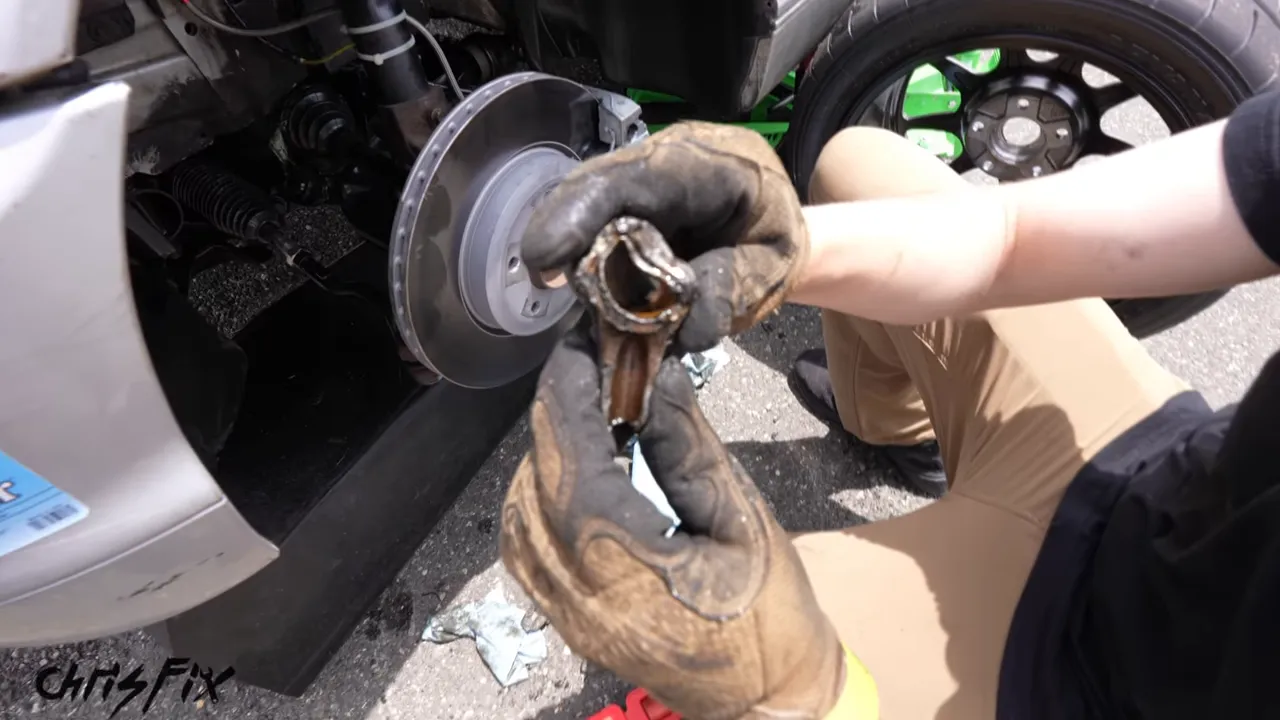
This wasn’t going to be a quick oil-leak repair. The engine had suffered a catastrophic internal failure.
Even then, the response around us wasn’t to give up. Jay encouraged us to start working the problem and find another engine. There were other BMW teams in the paddock, and possibly a spare engine somewhere nearby.
After a few calls, a local junkyard said it had an engine. Aaron and Pierce headed out to collect it while the rest of us prepared the car.
Then Garage Heroes in Training stopped by and offered their garage space and portable lift. Another team later loaned us an engine hoist. Without that help, attempting the swap at the track wouldn’t have been possible.
That was one of the coolest parts of the weekend. These were teams competing in the same race, yet they were helping us try to get back into it.
Attempting an M54 Engine Swap at the Track
The replacement was a 3.0-liter BMW M54, the same engine family as ours. We thought we could swap it in and get back to racing.
At noon, our deadline was 3 p.m. the following day. None of us had swapped an engine out of an all-wheel-drive BMW before, so we were about to learn a lot under pressure.
Removing the Front End and Draining the Oil
We started by taking off the front clip and removing the radiator. That opened up plenty of space in front of the engine, and initially, things moved along nicely.
When we drained the damaged engine, there was still a surprising amount of oil inside. Other racers had described the enormous smoke cloud, so we hadn’t known how much would remain. We collected a sample to send out for analysis.
At that point, our working theory was an oil-pump problem. We suspected the M54’s oil pump nut might have loosened at high rpm, allowing the pump to stop working even though oil remained in the engine.
That was a suspicion, not a confirmed diagnosis. Finding the broken rod established the damage, but we still needed a teardown to understand what started it.
Removing the Exhaust and Discovering the AWD Complication
Next, we removed the exhaust so we could drop the transmission. The complete exhaust weighed about 75 pounds, making it a pretty substantial piece to move around under the car.
Aaron and I had also shared one complaint from our driving stints: the BMW was too quiet. We could hear everyone else’s car but had trouble hearing our own. Since the muffler weighed about 30 pounds, we found time to cut it off while the exhaust was already out.
Was that the most urgent job? Probably not. But we took the opportunity.
About three hours in, we thought we had nearly everything disconnected. We attached the borrowed engine hoist and tried pulling the engine.
It wouldn’t come out.
On our all-wheel-drive BMW, we found that the engine and transmission couldn’t come out as we were attempting with the front subframe still installed. We removed the subframe, tried again, and discovered another connection we had missed: the clutch hydraulic line.
Once that was disconnected, the engine finally came free.
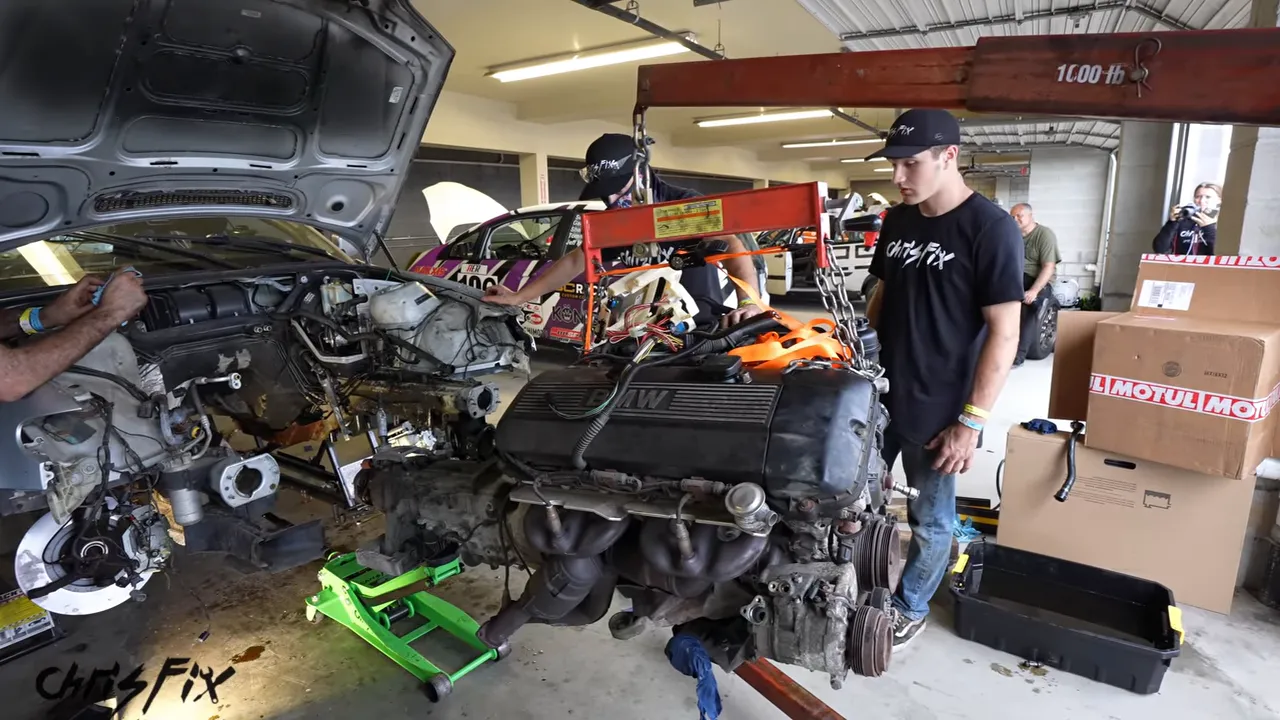
With the engine out, the damage was unmistakable. There was a hole in the block. Somehow, the engine had continued running after the rod failure, and Aaron had traveled roughly another half-mile before shutting it down.
I didn’t know whether to be upset or impressed. Either way, that engine was done racing.
Preparing the Replacement Until 4 A.M.
As the night went on, we prepared the junkyard engine for installation. Because we suspected an oil pump nut issue, securing that nut became a priority. We applied red threadlocker and torqued it down.
That describes what we did during our trackside repair attempt, not a confirmed cure for the original failure or a complete M54 race-engine preparation procedure.
By 4 a.m., fatigue was catching up with everybody. We finished tightening the nut and decided to stop for the night.
Unfortunately, a hotel room mix-up consumed what little rest time we had left. By the time it was sorted out, it was practically time to return to the track. None of us got meaningful sleep.
The Same Engine Family Didn’t Mean a Direct Swap
Back at the garage, we were exhausted, morale was low, and there were only a few hours left in the race. We kept working, but the replacement engine was creating problem after problem.
The donor engine had come from a BMW X3. It was an all-wheel-drive vehicle with the same 3.0-liter M54 engine family, but its wiring harness didn’t match our car’s connections. The ECU connections weren’t compatible with our setup, either.
We began removing the X3 harness so we could transfer the original harness from our damaged engine. I left the donor wiring hanging nearby as a reference for where everything had been routed.
This was a major lesson: matching the engine family and displacement wasn’t enough to guarantee a quick installation. We still had to account for the differences between the donor vehicle and our E46.
In the end, we ran out of time. The replacement engine wasn’t installed, and we weren’t going back on track that weekend. We reinstalled the subframe so the BMW could roll and prepared to bring it home.
Our New Goal: Finish the Endurance Race
As the race ended, we headed over to cheer for the teams that had made it through the weekend. Seeing the finishing cars parade past gave all of us the same goal for next time: we wanted our BMW in that line.
At the awards ceremony, Unfit for Racing took first in Class A, The C Team won Class B, and BRF Racing won Class C. Those teams had done what we still needed to learn how to do: make it to the finish.
Our weekend ended with us pushing the BMW into the trailer, its disconnected driveshaft hanging underneath. Not exactly the triumphant finish we had pictured.
But we were already talking about the next race.
We needed better rearward visibility, a proper cooling-suit routine, more preparation time, and a better understanding of the engine failure. The damaged M54 would get a complete teardown so we could investigate what went wrong instead of simply installing another engine and hoping for the best. That investigation is covered in the BMW engine failure teardown.
My first time racing a car was exciting, overwhelming, exhausting, and a whole lot shorter than I expected. The BMW felt fantastic when it was running, and getting out there with my friends was something special.
The biggest lesson was simple: before trying to finish first, learn how to finish. We came home with a broken engine, but we also came home knowing exactly why we wanted to try again.


